

Artificial Intelligence is rapidly transforming how businesses operate, automate workflows, and engage with customers. With the rise of Large Language Models (LLMs) such as GPT, Claude, Gemini, and open-source alternatives, developers are increasingly building sophisticated AI agents capable of reasoning, decision-making, and task execution.
However, creating powerful AI applications is only half the challenge. Understanding how these agents behave in real-world environments is equally critical. This is where developer platforms and agent observability become essential.
What Are AI Agents?
AI agents are intelligent software systems that can perceive information, make decisions, and take actions to achieve specific goals. Unlike traditional chatbots, modern AI agents can:
- Use external tools and APIs
- Search databases and knowledge bases
- Execute workflows automatically
- Perform multi-step reasoning
- Learn from interactions
- Collaborate with other AI systems
Examples include:
- Customer support agents
- Sales assistants
- Personal productivity agents
- Research assistants
- Automated business workflow agents
- AI-powered CRM assistants
What Are LLM Applications?
Large Language Model (LLM) applications are software products built using foundation models that can understand and generate human-like language.
Popular use cases include:
- Content generation
- Code generation
- Customer support automation
- Document analysis
- Knowledge management systems
- Virtual assistants
- Data extraction and summarization
As businesses increasingly adopt AI solutions, developers require reliable platforms to build, deploy, monitor, and optimize these applications.
The Rise of AI Agent Development Platforms
Modern AI development platforms simplify the process of building and managing AI-powered systems.
These platforms typically provide:
Model Integration
Developers can connect multiple AI models such as:
- OpenAI GPT
- Anthropic Claude
- Google Gemini
- Meta Llama
- Mistral AI
This flexibility allows teams to choose the best model for specific tasks.
Workflow Orchestration
AI agents often perform complex multi-step tasks.
Developer platforms help orchestrate:
- Data retrieval
- Reasoning chains
- API calls
- User interactions
- Automated actions
Tool and API Integration
AI agents become significantly more powerful when connected to external tools.
Examples include:
- CRM systems
- Email platforms
- Databases
- ERP systems
- Project management software
- WhatsApp Business APIs
What Is Agent Observability?
Agent observability refers to the ability to monitor, analyze, and understand how AI agents behave during execution.
Just as software developers use monitoring tools for applications, AI developers require visibility into agent performance and decision-making processes.
Agent observability helps answer critical questions:
- Why did the agent generate a specific response?
- Which tools were called?
- Did the agent complete the task successfully?
- Where did failures occur?
- How much did each interaction cost?
- Which prompts produce the best results?
Without observability, debugging AI systems becomes extremely difficult.
Why Agent Observability Is Essential
1. Improved Reliability
AI agents can occasionally hallucinate, make incorrect assumptions, or fail to complete workflows.
Observability tools help identify:
- Response errors
- Failed executions
- Tool failures
- Logic breakdowns
This enables teams to improve system reliability.
2. Faster Debugging
Traditional debugging methods are often insufficient for AI applications.
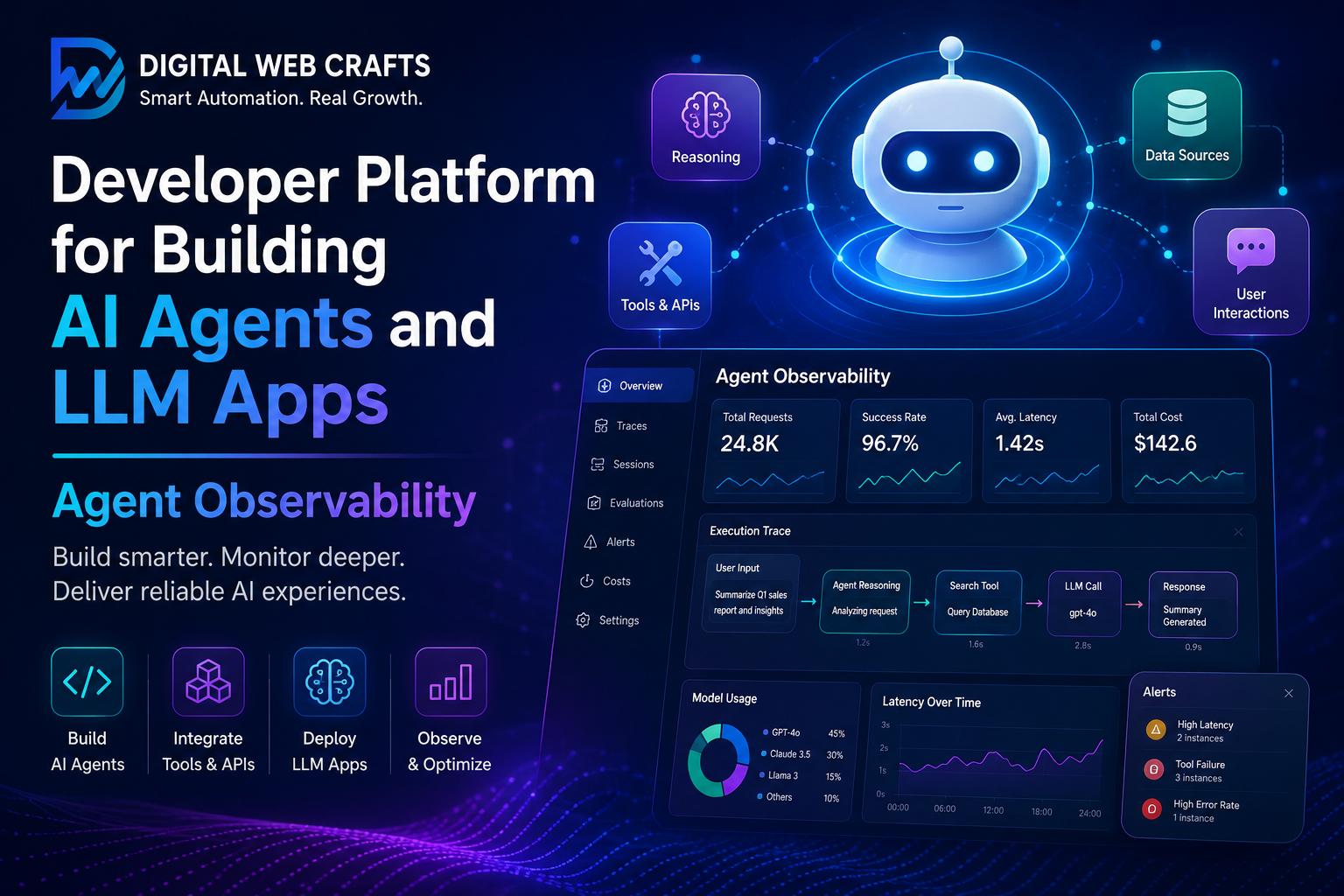
Observability platforms provide detailed traces showing:
- User inputs
- Agent reasoning paths
- Tool usage
- Model outputs
- Final responses
Developers can quickly pinpoint issues and optimize performance.
3. Cost Monitoring
Running LLMs can become expensive, especially at scale.
Observability platforms track:
- Token usage
- API costs
- Model performance
- Resource consumption
Businesses gain visibility into AI spending and can optimize costs accordingly.
4. Performance Optimization
Monitoring helps teams understand:
- Response latency
- Completion rates
- Accuracy levels
- User satisfaction metrics
These insights allow continuous improvement of AI systems.
5. Security and Compliance
Organizations handling sensitive data must maintain transparency and control.
Observability supports:
- Audit trails
- Compliance reporting
- Data governance
- Access monitoring
This is particularly important in industries such as healthcare, finance, and legal services.
Key Metrics to Monitor
When building AI agents, developers should track:
Operational Metrics
- Request volume
- Response times
- Error rates
- System uptime
LLM Metrics
- Token consumption
- Model latency
- Completion success rates
- Prompt effectiveness
Agent Metrics
- Task completion rates
- Tool execution success
- Reasoning accuracy
- User satisfaction
Benefits for Businesses
Organizations implementing AI observability gain several advantages:
Better Customer Experiences
Reliable AI agents provide:
- Faster responses
- Accurate information
- Consistent service quality
Reduced Operational Risks
Observability helps identify issues before they impact customers.
Lower AI Costs
Monitoring enables businesses to optimize model usage and reduce unnecessary expenses.
Scalable AI Operations
As AI deployments grow, observability becomes critical for maintaining quality and performance across multiple agents and workflows.
The Future of AI Agent Development
The next generation of AI systems will be more autonomous, collaborative, and capable of handling increasingly complex tasks.
As businesses deploy AI agents across sales, customer support, operations, marketing, and analytics, observability will become a foundational requirement rather than an optional feature.
Organizations that invest in robust AI development platforms and observability frameworks today will be better positioned to scale AI initiatives successfully and responsibly.
How Digital Web Crafts Helps Businesses Implement AI Solutions
At Digital Web Crafts, we help businesses design, develop, and deploy AI-powered solutions that drive measurable results.
Our services include:
- AI Agent Development
- Custom LLM Applications
- Workflow Automation
- CRM Integration
- WhatsApp Automation
- AI Chatbots
- Agent Monitoring & Optimization
- Business Process Automation
Whether you’re building your first AI-powered application or scaling enterprise-grade AI systems, our team can help create secure, reliable, and intelligent solutions tailored to your business needs.
Ready to build smarter AI systems? Contact Digital Web Crafts today and discover how AI agents and observability can transform your business operations.